Horizon Worlds: A Community of Practice for Social VR Design
Published:
Social virtual-reality platforms are simultaneously software products, public spaces, and creative tools. We studied Horizon Worlds shortly after its early public expansion to understand how those roles were negotiated by its users. Rather than evaluating the headset or interface in isolation, we focused on the practices through which people built worlds, learned from one another, formed roles, and handled conflict.
Our group conducted roughly 50 hours of participant observation across creator meetups, world tours, comedy clubs, music spaces, and other social worlds. We also interviewed six community members, most of whom were creators, and examined activity on related Facebook and YouTube communities. This produced a qualitative account of both activity inside Horizon and the peripheral platforms used to coordinate it.
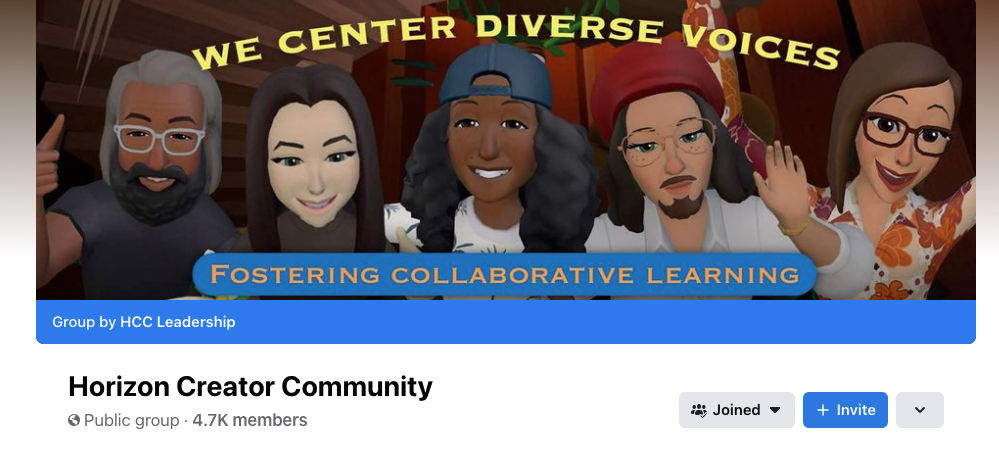
We found that the creator community closely resembled a community of practice: members developed competence through recurring interaction, observation, collaboration, and progressively more substantial participation. Introductory creation events and office hours made expert practice visible to newcomers. Experienced builders recruited collaborators, while visitors and testers shaped worlds through repeated feedback. Creative work also supported an emerging commission economy and recognizable community roles.
The same openness created governance problems. Trolling, harassment, inconsistent occupancy, and the difficulty of maintaining contact after an encounter affected both participation and recruitment for our study. Platform moderation tools therefore did more than remove individual violations; they influenced whether events could function as dependable social spaces.
This was a bounded ethnographic course study conducted during a particular stage of a rapidly changing platform. The full report includes our methods, observations, interviews, and analysis.