Perceived Credibility of Public Health Messages
Published:
Public-health guidance is only useful when people consider it credible enough to act on. During the COVID-19 pandemic, the same message could appear on an agency website, in a social-media post, or without visible platform context. This course study examined whether perceived credibility changed with the institutional source of a message, the platform on which it appeared, or the interaction between the two.
We conducted a mixed-design survey experiment with 51 Georgia Tech undergraduates. Participants evaluated text-based public-health announcements attributed to a national agency, a state agency, an academic source, or an unknown source. They were also assigned to one of three platform presentations: an official website, Twitter, or a neutral presentation without an identified platform. Credibility was measured using an established public-health trust scale.
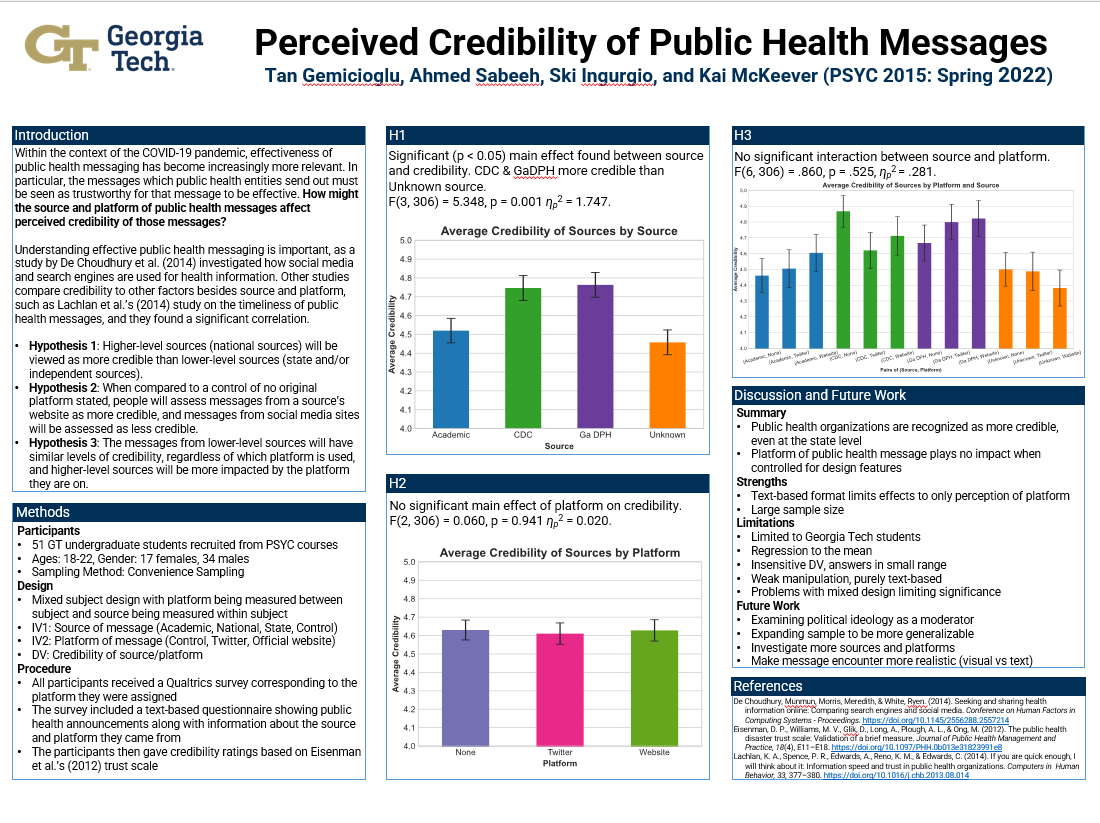
Source affected credibility: messages attributed to the CDC and Georgia Department of Public Health were rated more credible than messages with an unknown source. We did not find a significant main effect of platform, nor an interaction between source and platform. In this controlled text-only presentation, knowing who issued the message mattered more than whether it was described as appearing on Twitter or an official website.
The result should be read within the study’s limits. The sample was young, drawn from one university, and the platform manipulation removed visual and social cues that often shape credibility online. A more realistic follow-up would recruit a broader population, reproduce the appearance and surrounding context of each platform, and examine moderators such as political ideology and prior trust in health institutions. The linked poster provides the study design, analysis, and references.