Autonomous Navigation for Mobile Robots in Open Terrain
Published:
The Intelligent Ground Vehicle Competition asks a mobile robot to navigate an outdoor course marked by painted boundaries, ramps, potholes, barrels, and GPS waypoints. Reliable autonomy therefore depends on the entire stack: mechanical traction, weather-resistant electronics, perception under changing light, localization, planning, low-level control, and a simulator capable of exposing failures before competition.
I joined RoboJackets’ RoboNav team as a software member and later served as project manager across the mechanical, electrical, and software subteams. My early work included motor-control firmware, path-planning changes, and a full-scale Gazebo reproduction of the competition course. The simulator combined a qualification area, open-terrain sections, and deliberately difficult edge cases so that navigation could be tested without waiting for access to the physical robot.
The later Jessiii platform used a ROS-based pipeline with camera and LiDAR perception, localization from several sensors, and global and local planning over a traversability map. Multiclass image segmentation identified lane boundaries, potholes, and barrels; LiDAR produced a height map for uneven terrain; and timed-elastic-band planning converted a route into motor commands. Automated tests used mock publishers and subscribers to verify message behavior without the robot.
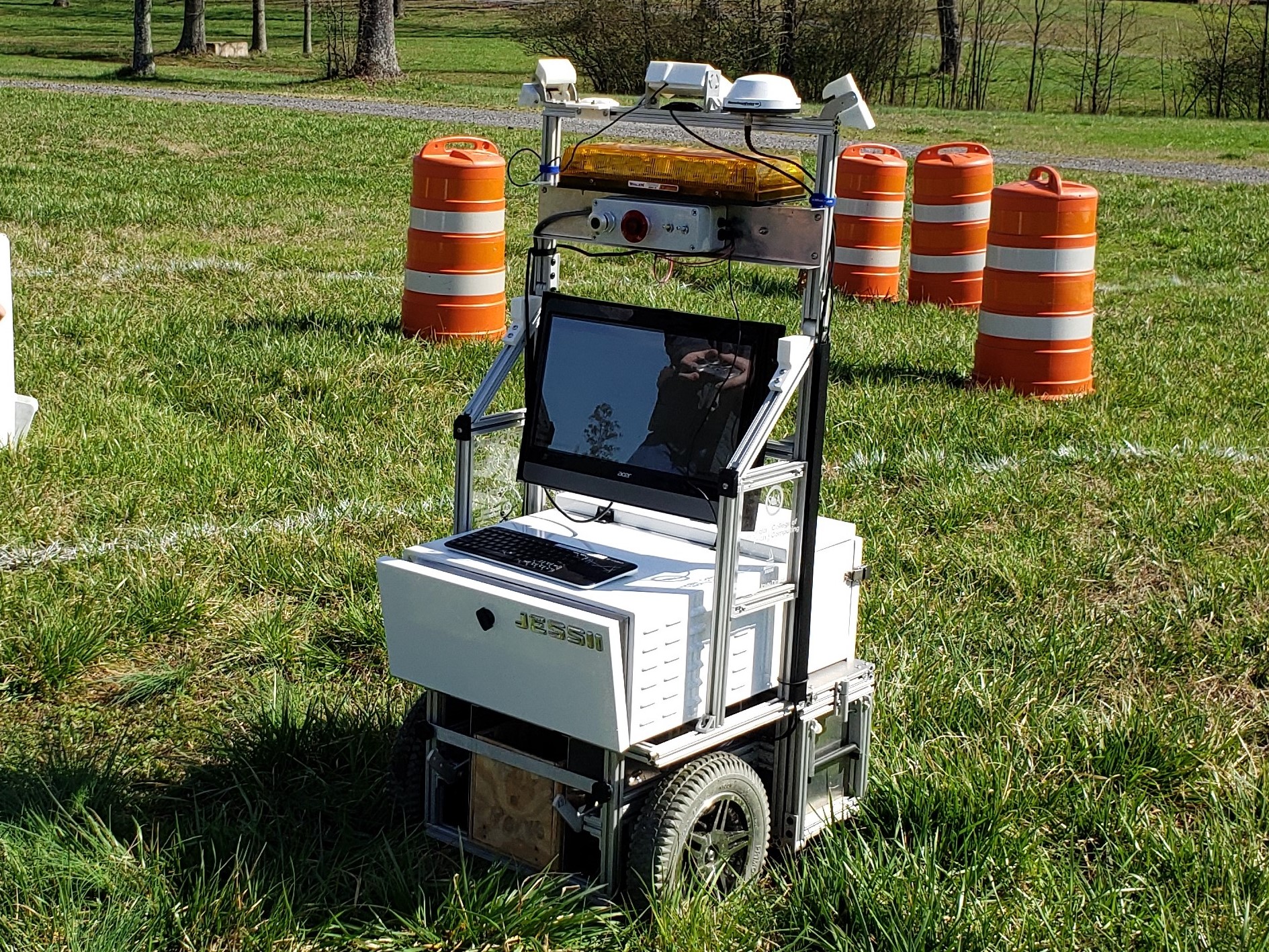
The design process was shaped as much by previous failure as by new features. Earlier runs exposed unreliable wiring, delayed planning responses, poor behavior around course boundaries, and insufficient side-camera data. The team responded with a rewired diagnostic network, recovery behavior, improved simulation, and explicit documentation of remaining failure points. That experience made the project an early lesson in treating robotics as systems engineering rather than a collection of individually impressive algorithms.
The design report describes the full 2021 robot, and the open-source repository contains the ROS packages and simulation environment.