SilentSpeller: Silent Speech Text Entry using Electropalatography
Published:
Speech interfaces leave an important gap between typing and speaking aloud. Audible speech can be inappropriate in a shared office, impossible in a noisy setting, or undesirable when a message is private. SilentSpeller investigated whether tongue movement could provide fast, hands-free text entry without requiring the user to vocalize.
The system uses a custom dental retainer with 124 capacitive electrodes on the palate. As a user silently spells a word, the tongue contacts different electrode patterns at 100 Hz. A recognition model interprets the resulting sequence and searches a language-model vocabulary. Because the sensor measures contact inside the mouth, it is less affected by whole-body motion than camera, acoustic, or surface-muscle approaches to silent speech.
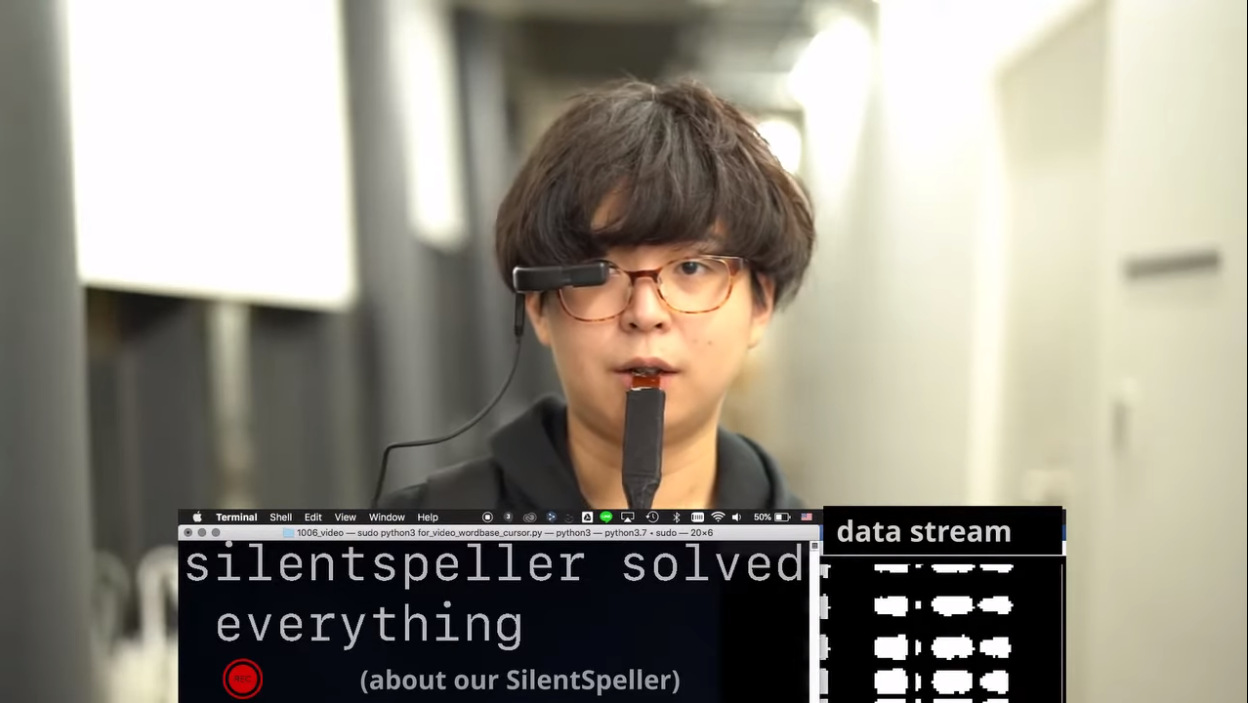
In offline testing on a 1,164-word vocabulary, SilentSpeller reached 97% average character accuracy. Performance was similar for phrases recorded while walking (97.5%) and seated (96.5%), and testing on 100 words not seen during training reached 94%. In live entry, seven participants averaged 37 words per minute at 87% character accuracy; the fastest demonstrations reached 53 words per minute.
These results showed that silent spelling could remain usable while mobile and scale beyond a small command set. They do not remove the practical barriers of the prototype: each retainer requires a dental impression, the hardware occupies the mouth, and longer-term comfort, hygiene, calibration, and recognition across changing speech patterns require further study.
SilentSpeller also reframes silent-speech interaction around spelling rather than reconstructing acoustics. This reduces training for people who already know how to spell, but makes performance depend on language and orthography. The CHI 2022 paper reports the complete study, and the linked video shows live use.