Passive Haptic Learning for Accelerated Learning of Piano
Published:
Passive haptic learning uses repeated tactile cues to teach a motor sequence while the learner is attending to something else. Earlier studies showed that vibration motors on the fingers could teach piano melodies, but passive exposure cannot replace the timing, force, and coordination learned by actively playing an instrument. We therefore reframed the technique as passive haptic rehearsal: tactile repetition supplements deliberate practice between sessions rather than serving as a complete lesson.
We built a system for use outside the laboratory. A lightweight glove delivered the fingering sequence through vibration motors, a light-up keyboard supported active practice, and a web portal organized lessons, recorded performance, and connected the devices. I led the student team working across glove manufacturing, the learning portal, and study operations.
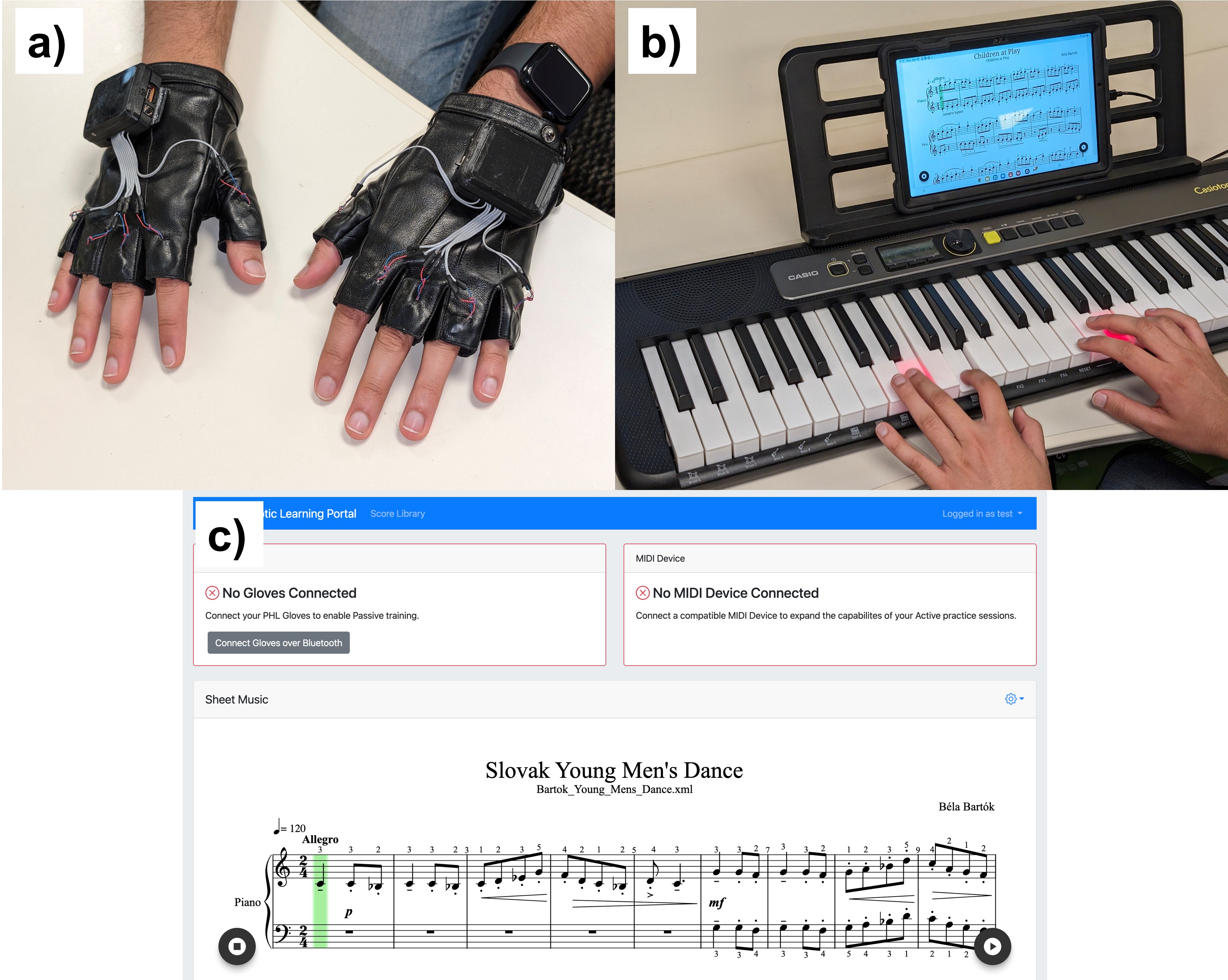
In a two-week study, 36 participants with prior musical experience learned two songs at home, one with passive rehearsal and one through active practice alone. Twenty participants provided complete and valid data for the primary analysis. Passive rehearsal increased the modeled learning rate for note-matching accuracy by 49.7%, corresponding to reaching the study’s mastery threshold about two days earlier. It also improved recall between practice sessions, but did not significantly improve learning of rhythm.
The distinction between note accuracy and rhythm matters. Repetition through the glove reinforced which fingers should move and in what order, while musical timing still depended on active coordination and feedback from the instrument. The results support passive rehearsal as a way to make limited practice time more productive, not as a substitute for attentive practice.
The project also exposed practical requirements that short laboratory demonstrations tend to miss: gloves need to survive daily wear, setup must be recoverable without a researcher, and a learning system must handle missing or inconsistent practice data. The IMWUT paper reports the longitudinal study, while the earlier interactive demonstration describes the lesson system.