Wardian: A Malleable Habitat for Local Agent Work
Published:
Most agent work still begins and ends as a disposable terminal session. The useful parts are scattered across scrollback, project files, prompts, and the operator’s memory; coordinating several agents often means remembering which window is doing what and reconstructing what happened after it finishes. I built Wardian around a different premise: local agent work should remain visible, durable, and malleable.
Wardian runs the CLI agents people already use in real project folders and gives that work a durable local home. A managed agent is not merely a terminal tab: it is a named working instance that combines a provider and model, project context, a reusable role, scoped skills, a live session, and reviewable results. Provider-specific adapters preserve the behavior of the underlying tools while exposing a common lifecycle for starting, observing, messaging, and coordinating them.
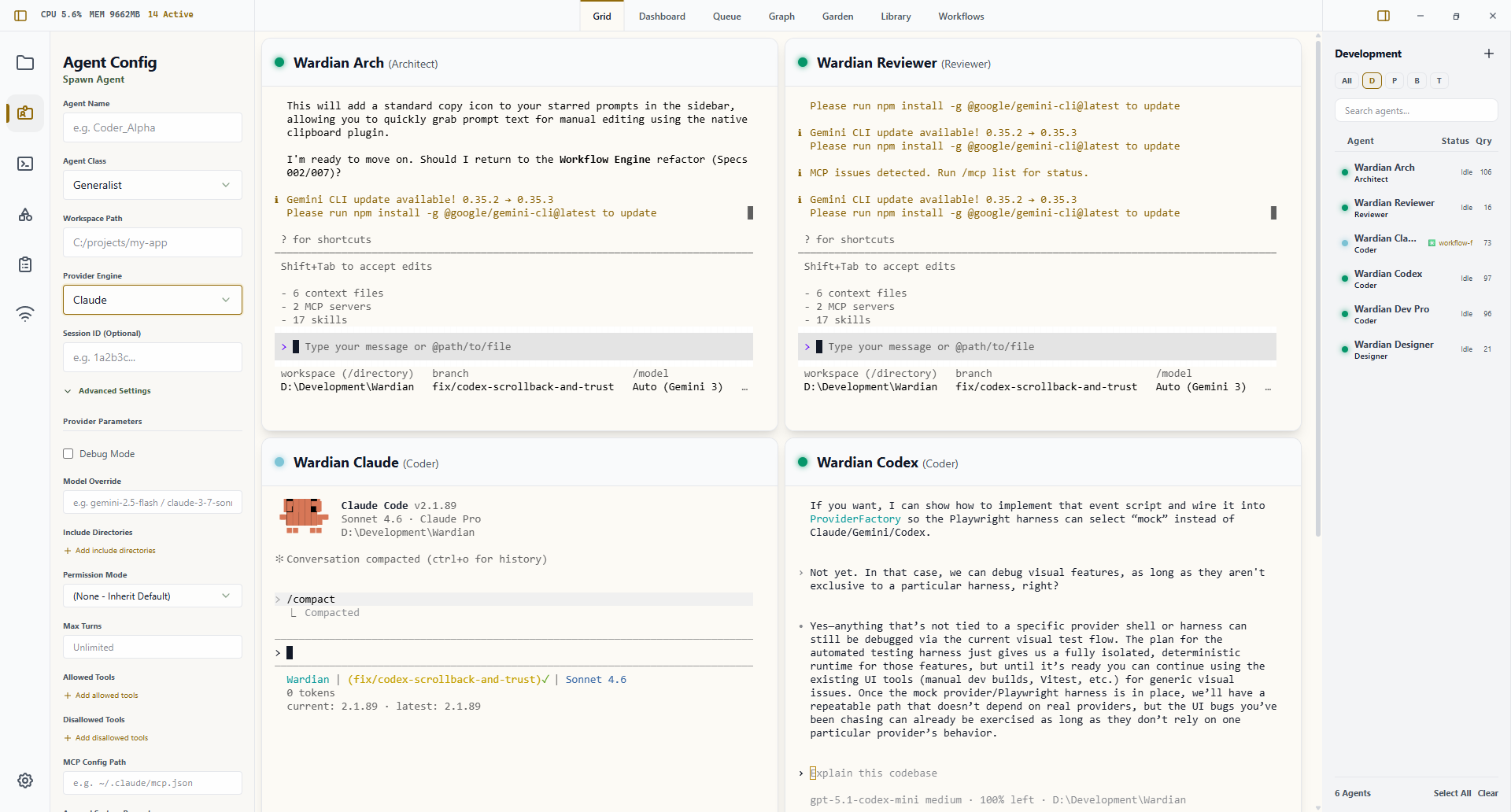
The desktop workbench is one view into that system, not its defining feature. Live terminals can sit beside source control, project files, the Inbox, automation runs, or reusable library material. A persistent roster, teams, watchlists, and the communication graph make relationships between agents explicit. Structured asks and replies preserve accountable handoffs, while Queue and automation records keep completions, failures, and action-needed work from disappearing into terminal scrollback.
Wardian also treats successful work as material that can be shaped. A recurring request can become a saved prompt; a reliable method can become a skill; a stable role can become an agent class; and a repeated multi-step process can become an automation. This gradual tailorability slope is central to the project. People can begin with one existing agent and adopt more structure only when their work demands it, rather than committing to a rigid orchestration framework in advance.
The underlying engineering is correspondingly broader than a terminal multiplexer. A Rust and Tauri runtime supervises real pseudoterminals, provider processes, delivery, status transitions, automations, and local persistence across Windows, macOS, and Linux. The React and TypeScript interface projects that state into movable work surfaces, while the bundled command-line interface lets agents and scripts inspect the roster, coordinate with peers, and run automations through the same local control layer.
Wardian is a working open-source system under active development. Current priorities include provider reliability, inspectable reusable artifacts, bounded coordination, and durable automation evidence; richer spatial organization and additional reusable integrations remain future directions. The system also motivates an ongoing study of how new users structure work across multiple persistent agents. The project site, source repository, and documentation describe the current release and its active development direction.