VibroTone: Wearable Vibrotactile Stimulation for Lower-Limb Spasticity
Published:
Lower-limb spasticity can persist long after stroke, tightening muscles around the hip, knee, ankle, and foot and making gait less predictable. Existing care often requires repeated access to rehabilitation specialists, medication, or injections. VibroTone examines whether low-amplitude vibrotactile stimulation can be delivered through an adjustable wearable as a complement to those treatments, including during rest and gait training.
We designed a flexible wrap that can be positioned over the Achilles tendon, gastrocnemius, or tibialis anterior. Four vibration motors, a rechargeable battery, and a custom control board are integrated into textile layers that balance protection, stretch, and skin contact. A single large button and status light minimize interaction demands, while onboard motion sensing and storage record device operation without requiring a phone or cloud connection.
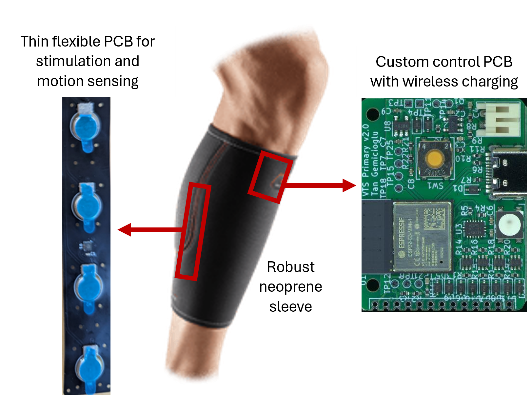
Lower-limb wear introduces constraints that do not appear in a hand or forearm device. The calf changes shape during walking, motors can shift away from the target, and the wrap must not collide with the opposite leg, shoes, or an ankle-foot orthosis. Silicone grip, elastic conformity, and adjustable circumferential tension help maintain placement, but each choice also changes how vibration couples into the body. Mechanical design is therefore part of stimulation delivery.
The ongoing two-phase study is planned for 24 participants. Its first phase compares stimulation locations using electrophysiological and functional measures. Its second uses a counterbalanced crossover design to compare stimulation at rest with stimulation delivered during gait training. The study is intended to evaluate feasibility and mechanism; outcomes should not be inferred before data collection and analysis are complete.
The project also foregrounds accessibility in setup. Some people with stroke have limited use of one hand or cannot comfortably reach the lower leg, so a nominally one-handed fastening mechanism may still require caregiver assistance. Clinicians, participants, caregivers, and researchers each need different ways to fit, clean, charge, configure, and verify the system. Designing those workflows is as important as miniaturizing the electronics.