AppetiteCheck: Momentary Vagus Nerve Stimulation During Eating
Published:
Most interactive systems for eating behavior work through information or deliberate action: they ask a person to record food, notice a cue, interpret feedback, or consciously slow down. AppetiteCheck explored a complementary possibility: apply a brief physiological intervention during an eating episode, while attention remains on another activity.
The project uses transcutaneous cervical vagus nerve stimulation (tcVNS), in which a mild electrical current is delivered non-invasively to the side of the neck. In a randomized within-subject study, 24 participants completed two distracted-snacking sessions on different days. They received tcVNS on the neck in one session and sham stimulation on the shoulder in the other, with order counterbalanced. Stimulation was applied with a handheld device while participants watched videos and ate a snack of their choice.
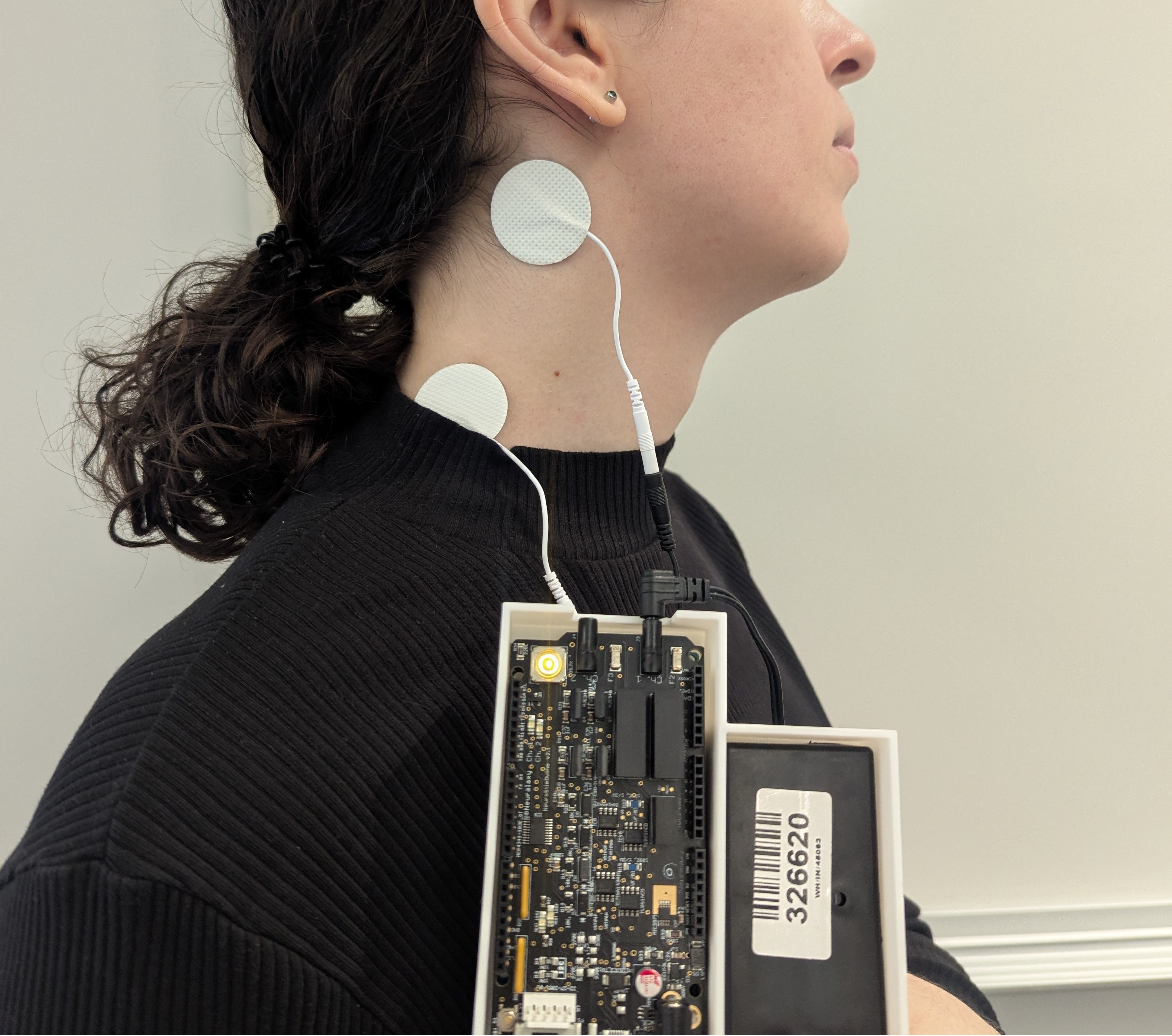
Participants ate 9.6% less and 23.6% more slowly under tcVNS than under sham stimulation. Eating episodes were about 2.8 minutes longer, while post-snacking satiety was similar in both conditions. Average heart rate was lower under tcVNS, but heart-rate-variability measures did not differ by condition. The physiological results therefore do not establish increased vagal tone or a specific mechanism for the behavioral effect.
Participants generally described the stimulation as subtle or vibration-like, but manual application constrained posture and sometimes interfered with movement or swallowing. Several preferred an autonomous wearable form factor. This makes the study a feasibility result for momentary stimulation, not a finished eating intervention: future work needs self-administered hardware, longer-term evaluation, and careful attention to safety, agency, and unintended effects.
The IMWUT paper reports the full AppetiteCheck study. It motivates future closed-loop systems that pair eating detection with low-attention physiological actuation, while preserving the user’s ability to understand, control, and stop the intervention.