BreathePulse: Peripheral Guided Breathing via Implicit Airflow Cues
Published:
Slow breathing can reduce stress and anxiety, but most guided-breathing systems make breathing into a second task. A visual animation must be watched, an audio cue occupies hearing, and a vibration has to be interpreted. BreathePulse explored whether airflow could provide a cue that maps more directly onto breathing and remain at the edge of attention during computer work.
The prototype mounts behind a laptop and directs a gentle stream of air toward the nose. Pulsing airflow marks inhalation and its absence marks exhalation, guiding the user toward approximately 75% of their normal respiratory rate. Because the sensation is physically aligned with the airway, the design aimed to reduce the translation required between an external cue and the desired breathing pattern.
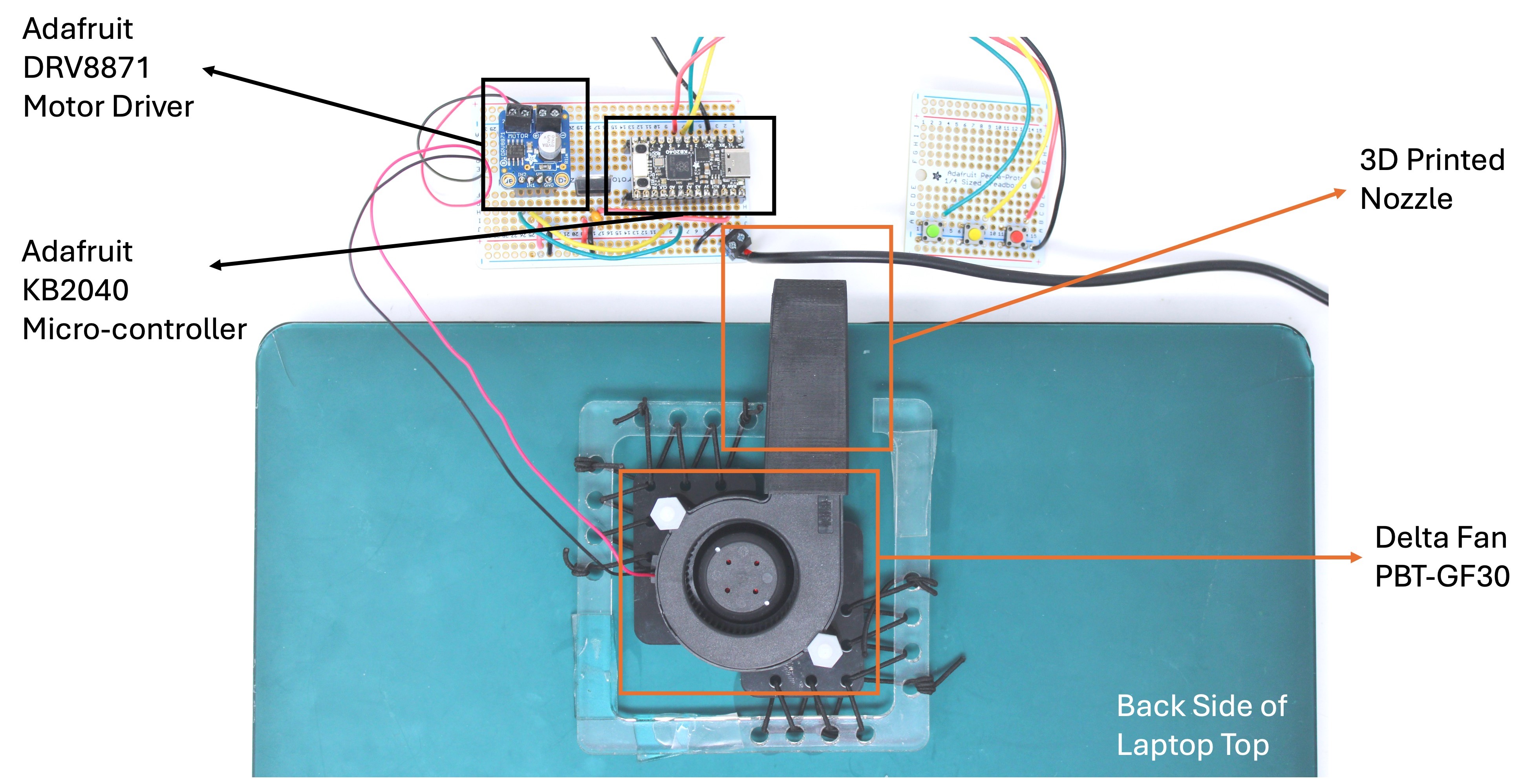
We evaluated BreathePulse with 23 participants performing easy and difficult N-back tasks under pulsing airflow, constant airflow, and no-airflow conditions. Participants’ breathing tracked the pulsing guide in both task conditions. Entrainment was strongest during the easier task, where participants remained at the target slow rate for more than 40% of the time.
The psychological results were more limited. Pulsing airflow did not produce a measurable reduction in stress or anxiety during the study, and it increased some dimensions of perceived workload. Participants nevertheless described the experience as promoting mindfulness. Together, these findings show that airflow can guide respiration during information work, while also showing that respiratory entrainment alone should not be treated as evidence of stress reduction.
The larger design lesson is that peripheral interventions still compete for attention. Future systems should adapt cue intensity and timing to workload, support periods when a user cannot comfortably follow the guide, and evaluate whether repeated use produces benefits outside a short laboratory task. The IMWUT paper reports the complete study and analysis.